<style>
/* Default Off-Canvas (Hidden) */
.e-off-canvas {
    z-index: 100;
    display: none;
    visibility: hidden;
    opacity: 0;
    transition: visibility 0s linear 0.2s, opacity 0.2s linear;
}

/* Show Off-Canvas */
.e-off-canvas-visible {
    display: block !important;
    visibility: visible !important;
    opacity: 1 !important;
    z-index: 9999 !important;
}

/* Hide Off-Canvas */
.e-off-canvas-hidden {
    visibility: hidden !important;
    opacity: 0 !important;
    z-index: 10 !important;
}

/* White Background Behind Off-Canvas (Using ::before on Body) */
body::before {
    content: "";
    position: fixed;
    top: 0;
    left: 0;
    width: 100vw;
    height: 100vh;
    background: rgba(255, 255, 255, 1); /* Solid White */
    opacity: 0;
    visibility: hidden;
    z-index: 9998; /* Just behind Off-Canvas */
    transition: opacity 0.2s linear, visibility 0s linear 0.2s;
}

/* When an Off-Canvas is Open, Show the Background */
body.off-canvas-active::before {
    opacity: 1;
    visibility: visible;
    transition: opacity 0.2s linear;
}
</style>

<script>
jQuery(function($) {
    // Function to force repaint/reflow
    function forceRepaint() {
        document.body.style.display = 'none';
        document.body.offsetHeight; // Force reflow
        document.body.style.display = 'block';
        window.dispatchEvent(new Event('resize'));
    }

    function closeAllOffCanvas(exceptID = null) {
        let anyOpen = false; // Track if another Off-Canvas remains open

        $(".e-off-canvas").each(function() {
            let canvasID = $(this).attr("id");

            if (!exceptID || canvasID !== exceptID) {
                $(this).removeClass("e-off-canvas-visible")
                       .addClass("e-off-canvas-hidden")
                       .attr("aria-hidden", "true")
                       .css({
                           "z-index": "10",
                           "visibility": "hidden",
                           "opacity": "0"
                       });

                // Full removal delay set to 0ms
                setTimeout(() => {
                    if ($(this).attr("aria-hidden") === "true") {
                        $(this).css("display", "none");
                    }
                }, 0);
            } else {
                anyOpen = true; // At least one Off-Canvas is still open
            }
        });

        // Remove white background delay set to 0ms
        setTimeout(() => {
            if (!$(".e-off-canvas-visible").length) {
                $("body").removeClass("off-canvas-active");
                forceRepaint(); // Force repaint when closing all
            }
        }, 0);
    }

    function openOffCanvas(targetID) {
        let targetCanvas = $(targetID);

        if (targetCanvas.length) {
            // Close all others EXCEPT the one we're opening
            closeAllOffCanvas(targetID);

            // Open immediately with delay set to 0ms
            setTimeout(() => {
                targetCanvas.removeClass("e-off-canvas-hidden")
                            .addClass("e-off-canvas-visible")
                            .attr("aria-hidden", "false")
                            .css({
                                "z-index": "9999",
                                "visibility": "visible",
                                "opacity": "1",
                                "display": "block"
                            });

                // Ensure the White Background Stays Visible
                $("body").addClass("off-canvas-active");
                
                // Force repaint after opening
                forceRepaint();

            }, 0);
        }
    }

    // Decode Base64
    function decodeBase64(str) {
        try {
            return atob(str);
        } catch (e) {
            return null;
        }
    }

    // Handle Elementor Off-Canvas OPEN clicks
    $(document).on('click', '[href*="elementor-action%3Aaction%3Doff_canvas%3Aopen"]', function(event) {
        event.preventDefault();
        let href = decodeURIComponent($(this).attr("href"));

        let base64Match = href.match(/settings=([^&]+)/);
        if (base64Match) {
            let decodedSettings = decodeBase64(base64Match[1]);

            try {
                let settingsObj = JSON.parse(decodedSettings);
                if (settingsObj.id) {
                    let offCanvasID = "#off-canvas-" + settingsObj.id;
                    openOffCanvas(offCanvasID);
                }
            } catch (e) {}
        }
    });

    // Handle Elementor Off-Canvas CLOSE clicks
    $(document).on('click', '[href*="elementor-action%3Aaction%3Doff_canvas%3Aclose"]', function(event) {
        event.preventDefault();
        closeAllOffCanvas();
    });

    // Ensure all Off-Canvas elements start hidden
    $(".e-off-canvas").each(function() {
        $(this).attr("aria-hidden", "true").css({
            "z-index": "10",
            "visibility": "hidden",
            "opacity": "0",
            "display": "none"
        });
    });

    // Handle same-page anchor link clicks
    $(document).on('click', 'a[href*="#"]', function(event) {
        let href = $(this).attr('href');
        if (href.indexOf('#') !== -1) {
            // Close all off-canvas widgets when an anchor link is clicked
            closeAllOffCanvas();
        }
    });

});
</script>
				
			
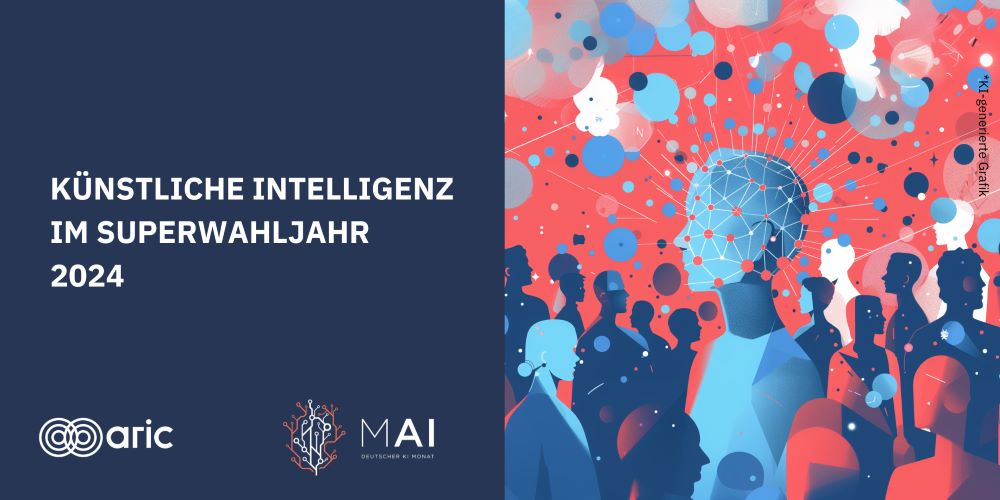
KI im Superwahljahr 2024, enhält eine KI-generierte Grafik

Lecture | AI in the super election year 2024

This post has been translated by an AI and may contain translational inaccuracies.
Wir betrachten die technischen und neurowissenschaftlichen Hintergründe, die den Einfluss von KI auf den Meinungsbildungsprozess prägen.

What role does artificial intelligence actually play in this super election year, in which more than 70 countries and around half of the world’s population will be voting? Marina Tcharnetsky, Anselm Fehnker and Dr. Natalie Rotermund from ARIC explain. They explain what phenomena are currently relevant, what has changed in recent years and what positive and negative effects AI has in this context. They will not only look at the technical aspects, but also explain the neuroscientific background that shapes the influence of AI on the opinion-forming process.

Our experts:

  • Marina Tcharnetsky, CBDO at ARIC
  • Anselm Fehnker, AI Manager at ARIC#
  • Dr. Natalie Rothermund, Scientific Officer at ARIC

This event is taking place as part of the Germany-wide AI month MAI. You can register free of charge via Eventbrite:

→ Register here ←


More on AI and elections:
AI-generated image
AI-generated image

The interdisciplinary internal ARIC working groupAI and Opinion Formation is currently preparing a paper on the topic.

→ To the presentation of the working group